Design and Solution
This section provides a detailed explanation of each stage of the design thinking model and presents the corresponding artefacts. For more information, please click the image link on the right.


What Are We Concerned About
Empathise(Month 1)
The main purpose of this stage is to understand the real classroom experiences of both teachers and learners, and to collect relevant data for defining the problem in the next stage. At this stage, the two key issues that need to be examined are the specific classroom behaviours and performances of learners and teachers, and the internal feelings and experiences of both sides. The questions are presented in the table below:
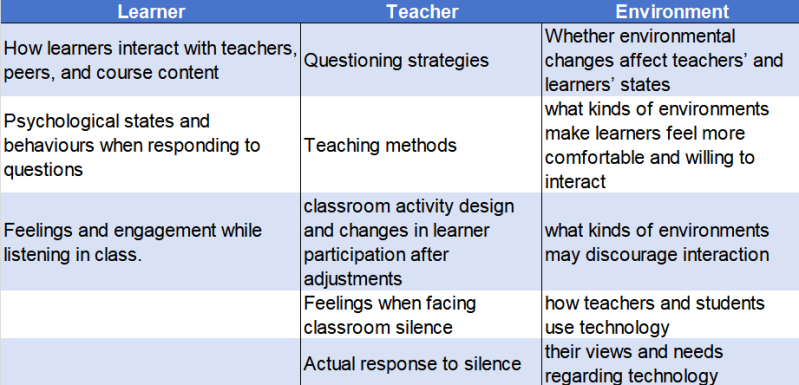
Questionnaires:
Survey for students:https://surveymars.com/q/39k0Uy9o5
Survey for Teachers:https://surveymars.com/q/diafBuhEs
Empathy Interview video
In this simulated interview, Dr Aria represents the teachers’ perspective in Australian higher education. The interview explores the following key areas:
(1) the comparison between her previous experience as a learner and her current experience as a teacher; (2) her observations of current classroom participation; (3) her feelings and responses when facing classroom silence; (4) potential factors affecting participation; and (5) her views on the use of technology-enhanced support.

Define (Month 2)
Based on the interview data and empathy mapping, students’ silence does not necessarily indicate a lack of cognitive engagement. Instead, silence may reflect the way learners negotiate language anxiety, cognitive load, peer relations and classroom norms (Chang & Brickman, 2018; Toyama & Yamazaki, 2021). However, when learners lack safe and low-risk channels to express their difficulties and needs, teachers may struggle to interpret the real reasons behind their silence. As a result, students' needs become invisible, teachers find it difficult to provide timely and targeted support, and low classroom participation may develop into a self-reinforcing negative cycle.

Empathy map of learners in Classroom participation©2026 — Mucheng Li

Empathy map of Teachers in Classroom participation©2026 — Mucheng Li

Ideate & Prototype (Month 3-5)
In this stage, designers need to engage in more divergent thinking and broadly consider the potential issues that may be faced by stakeholders and during technological development, as well as possible solutions to these issues (Stanford d.school, 2018). In this project, the ideation stage will be carried out alongside the prototype stage, creating a natural feedback loop.
Based on users’ existing technological preferences and the problems defined in the previous stage, the following four design principles have been identified:
- Operationally, the product should be easy and simple to use;
- Cognitively, it should be engaging, attractive, and reduce cognitive load;
- Emotionally, it should be enjoyable, active, and supportive of a sense of belonging;
- Visually, it should be simple, aesthetically pleasing, and harmonious.


