Is Your Classroom Losing Energy?
Do You Often Face Silence After Asking a Question?
Do You Feel Lost When the Teacher Asks You to Respond?


Do You Truly Feel Engaged in Class?
While classroom participation is often seen as a visible indicator of course quality, it can also reveal the underlying power relations within the classroom.
Low classroom participation should not be understood simply as a lack of student willingness, but as the outcome of interactions among teachers, learners, content knowledge, educational technologies, and the learning environment.

Image © Monash University-Faculty of Education-EDF5647-Week 7
The classroom we are situated in, namely the physical learning environment, should not be understood as a passive background. Instead, it is an important condition that shapes how teachers and learners perceive, process, and respond to information. For example, spatial arrangement, sound, screens, platform interfaces, and digital tools can all influence how information is presented, received, and transformed. To some extent, the classroom environment can either support or constrain the use of different pedagogical approaches, while also shaping learners’ psychosocial learning experiences (Closs et al., 2022).
From a technological perspective, educational technology is often treated as a supplementary tool. However, when it is embedded in the classroom environment, it can reorganise teachers’ pedagogical practices, learners’ pathways of participation, and the ways in which course content is represented. Mishra and Koehler (2006) indicate that content, pedagogy, and technology are interconnected in complex and subtle ways. In this sense, technology may make content knowledge more vivid and accessible, but it may also limit how teaching content is designed and expressed because of its specific forms and functions.
Furthermore, within learner-centred pedagogy, learners’ cognitive, emotional, and behavioural states still need to be carefully considered. These states directly influence how learners understand, process, and transform knowledge, and they further shape the quality of classroom interaction. A study on classroom engagement among medical students in Chinese universities found that students who showed stronger emotional engagement with the classroom and learning content tended to achieve better learning outcomes. This is because higher emotional engagement often reflects stronger intrinsic motivation, which encourages learners to invest more effort in achieving their learning goals (Xu et al., 2023).
For anxious learners, feeling included, accepted, and free from judgment is an important condition for classroom participation. This is because anxious learners may fear expressing themselves under the gaze of others. Such fear can create a strong sense of insecurity and may be accompanied by symptoms such as a faster heartbeat or difficulty breathing. As a result, learners may find it difficult to express their ideas freely and meet their own expectations in public classroom settings (Grieve et al., 2021). Kahu and Nelson (2018) also suggest that students’ learning experiences are shaped by several psychosocial dimensions, including their confidence in completing academic tasks, emotional responses to the learning situation, sense of belonging to the institution and learning community, and overall well-being, which is partly affected by stress and life pressures.
In addition, the design of knowledge content itself can also influence classroom participation. This includes whether the course objectives are clear, whether the tasks across different units are coherent, whether classroom activities are aligned with learning outcomes and assessment requirements, and whether the curriculum develops the knowledge, capabilities, and employability skills that learners need for the future. If the level of course difficulty exceeds learners’ current stage of development (de Jong, 2010), or if learners have not prepared for the course content in advance, they may choose to remain silent because of excessive cognitive load. This is because stronger prior knowledge can support learners’ working memory, making it easier for them to understand and engage with new content, which may further improve participation (Dong et al., 2020). On the other hand, if the course content is too simple or has little connection to future career development, students may also lack motivation to participate (Harris-Reeves et al., 2024). Mishra and Koehler (2006) criticise unsuccessful curricula for often combining disconnected elements without a clear foundational framework that explains how learning and knowledge construction should occur.
Therefore, classroom participation should be understood as a dynamically formed classroom ecological phenomenon, rather than as an outcome determined only by the willingness or ability of individual students or teachers.
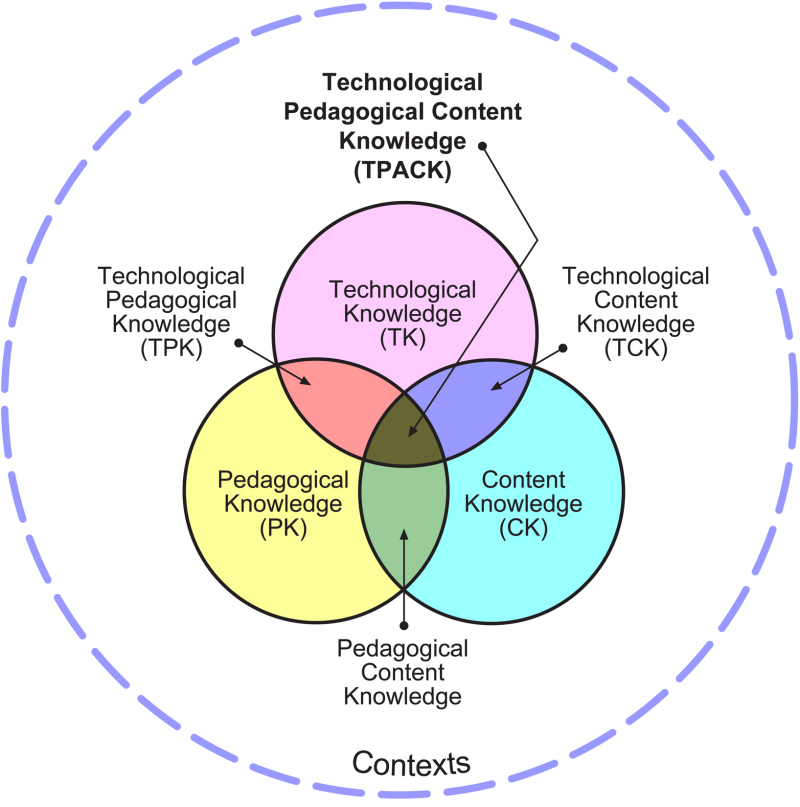
Image ©2012 by tpack.org
In international classroom contexts, participation is further shaped by language barriers and cross-cultural differences.
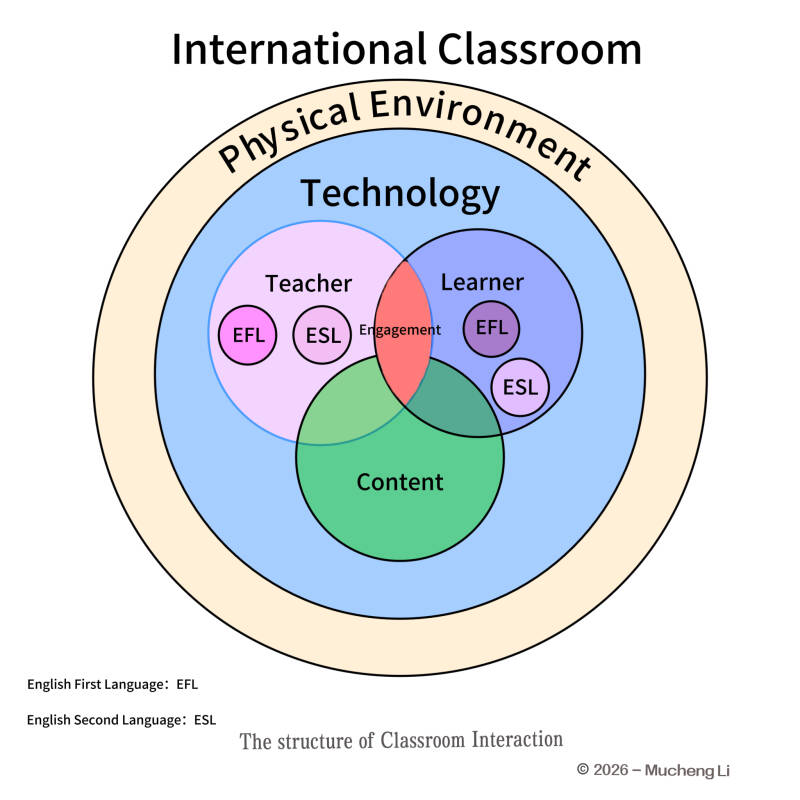
Students from diverse linguistic and cultural backgrounds may differ in their ways of thinking, communication styles, and expectations of classroom interaction. These differences can lead to unequal access to information, reluctance to question teachers’ views, and increased cognitive load caused by bilingual translation (De Coelho et al., 2024). Such challenges may make it difficult for learners to fully understand each other’s intended meanings. They may also feel anxious about expressing their views in public, which can lead them to avoid classroom interaction, even when they are encouraged to participate in discussion and speak in class (Bai & Wang, 2022).
These forms of classroom silence may also create frustration and pressure for teachers. When learners resist active communication or avoid building connections with others, teachers may find it difficult to identify the specific reasons behind their silence and may not fully understand these learners’ needs (Murray & McConachy, 2018). In addition, international students’ participation is shaped by peer relations. If learners feel excluded from group discussions, or worry that their language proficiency may negatively affect group performance, they may become less willing to contribute to group work and classroom discussion (Popov et al., 2012).
However, whether classroom participation is an issue worth discussing remains contested.
In Western universities, active classroom participation is often taken for granted as an expected student behaviour. Participation refers not only to students’ attention to information or ideas, but also to specific forms of interaction (Murray & McConachy, 2018). However, the pursuit of particular visible forms of participation may gradually make classroom interaction more formalised and performative. Macfarlane (2015) critiques the culture of presenteeism in contemporary higher education, arguing that it may deprive learners of the right to choose whether and how they participate in class. He also criticises learnerism, through which the classroom becomes a space where students are expected to perform their understanding of knowledge and comply with the rules and constraints imposed by the learning environment.
In contrast, De Coelho et al. (2024) suggest that an active classroom atmosphere can enhance the overall quality of teaching and learning. Participatory, interactive, and feedback-rich classrooms can help learners develop a deeper understanding of disciplinary knowledge and support the development of future professional skills. Therefore, the issue of classroom participation should not be reduced to whether students speak or remain silent. Rather, it should be understood as a complex debate involving visible participation, cognitive engagement, learner agency, and teaching quality.
Therefore, low classroom participation and active engagement can be understood as a wicked problem!
Click Next to the Wicked problem page